Monthly Features work to highlight important work being done by our research staff and to educate those in our community
Check out our latest monthly features and some of our past ones down below!
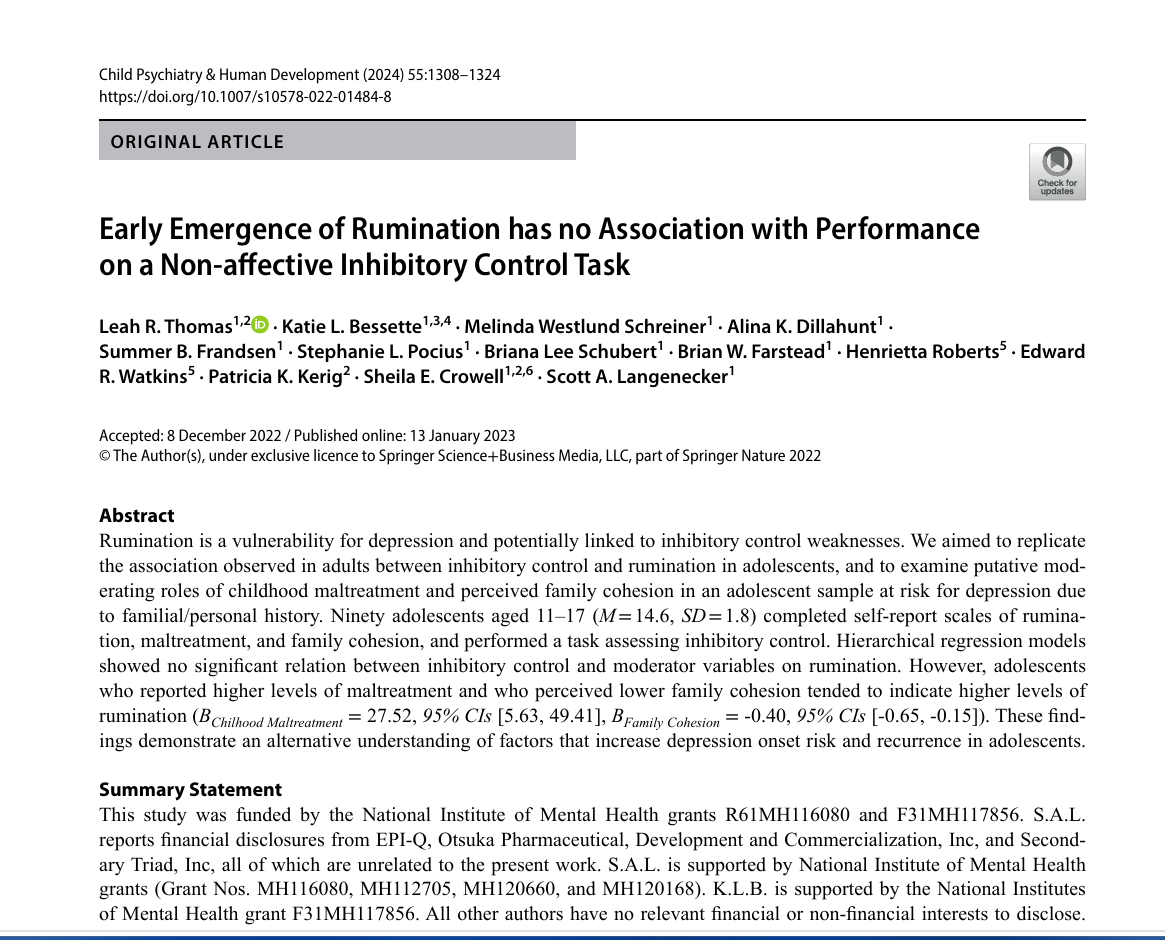
Leah R. Thomas, Katie L. Bessette, Melinda Westlund Schreiner, Alina K. Dillahunt, Summer B. Frandsen, Stephanie L. Pocius, Briana Lee Schubert, Brian W. Farstead, Henrietta Roberts, Edward R. Watkins, Patricia K. Kerig, Sheila E. Crowell, Scott A. Langenecker
Rumination is a vulnerability for depression, and rumination may be linked to inhibitory control weaknesses in adolescents. Rumination and inhibitory control are two proposed cognitive vulnerabilities for depression. Cognitive vulnerabilities of depression are influenced by other risk and resilience factors of depression (childhood maltreatment and supportive family environments). In a sample of 90 adolescents aged 11-17, there was no significant relationships between inhibitory control and moderator variables on rumination. Adolescents who reported more maltreatment and had lower perceived family cohesion were seen to rumination more.
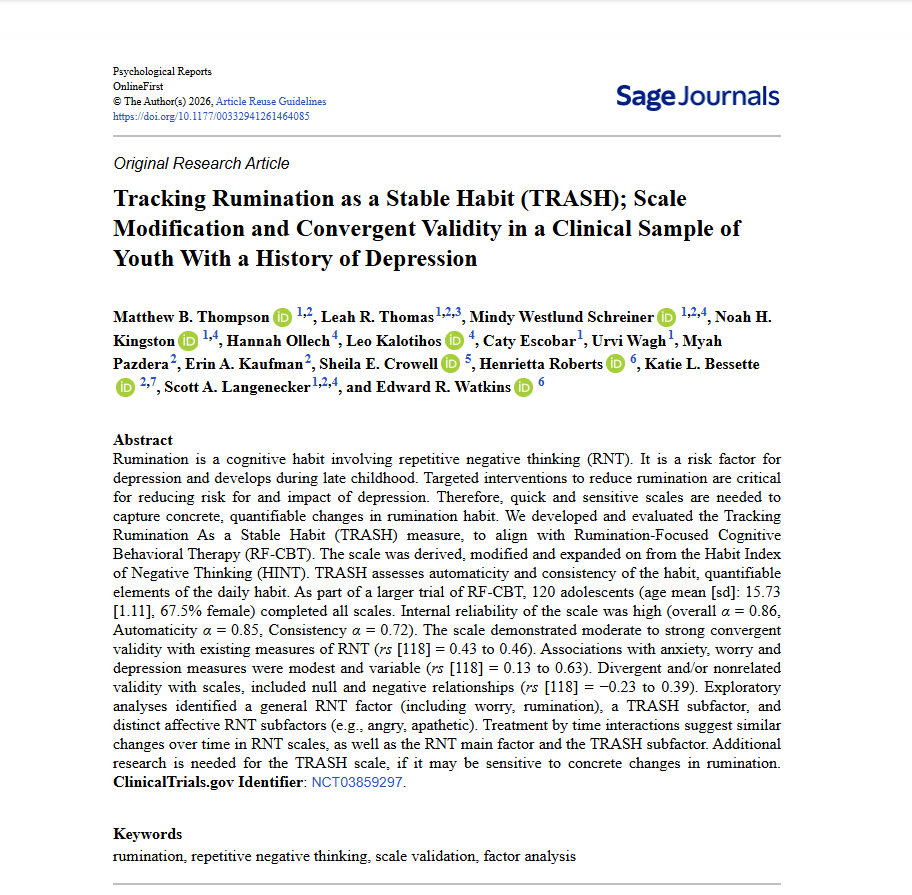
Matthew Thompson, Leah Thomas, Mindy Westlund Schreiner, Noah Kingston, Hannah Ollech, Leo Kalotihos, Caty Escobar, Urvi Wagh, Myah Pazdera, Erin Kaufman, Sheila Crowell, Henrietta Roberts, Katie Bessette, Scott Langenecker, and Edward R. Watkins
Rumination is a risk factor for depression and develops during late childhood. With these, quick and sensitive scales are needed to capture the ruminative habit in youth. The Tracking Rumination as a Stable Habit (TRASH) measure aligns with Rumination-Focused Cognitive Behavioral Therapy (RF-CBT) and was tested amongst 120 adolescents in RF-CBT. Internal reliability of the scale is high, and the scale demonstrates moderate to strong convergent validity with existing measures of repetitive negative thinking.
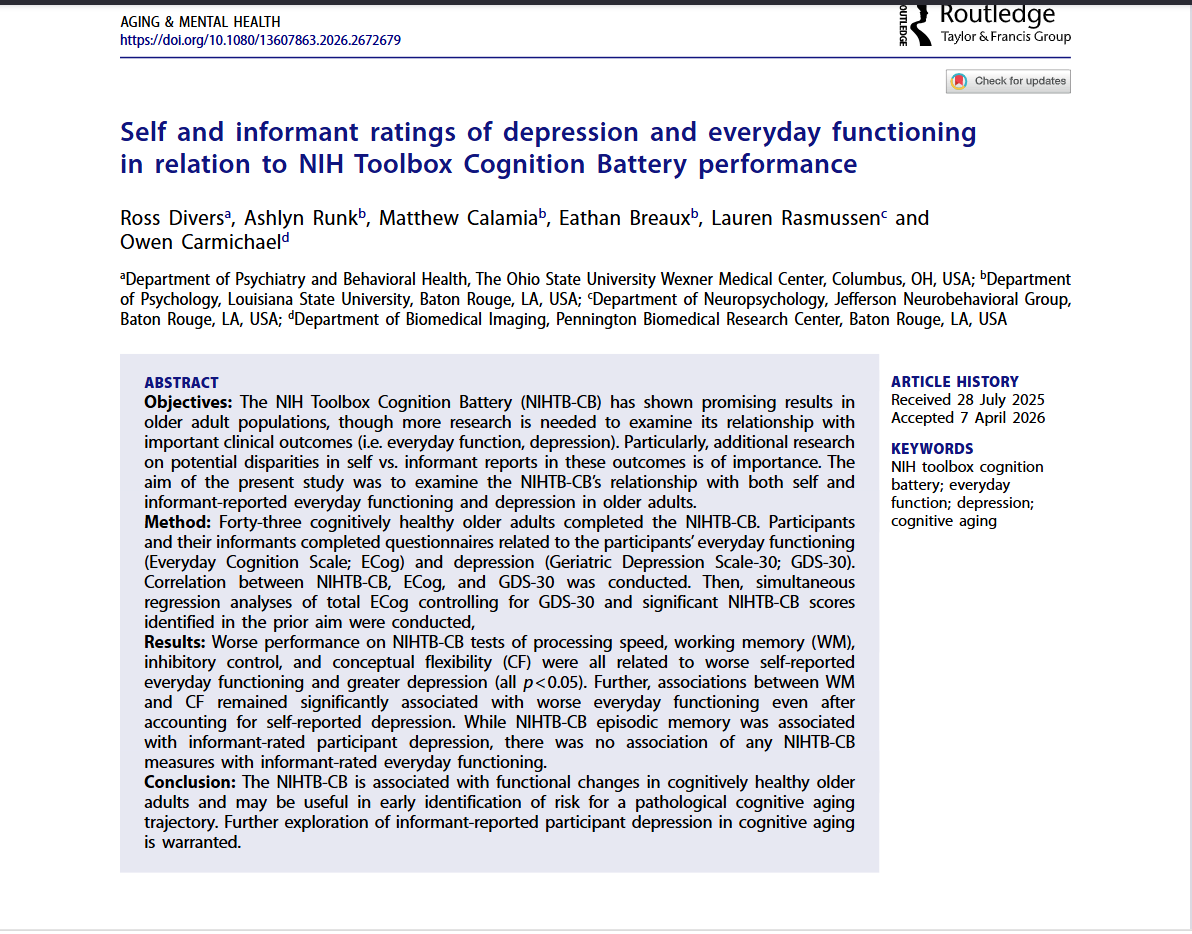
Ross Divers, Ashlyn Runk, Matthew Calamia, Eathan Breaux, Lauren Rasmussen & Owen Carmichael
Forty-three cognitively healthy older adults completed the NIH Toolbox Cognition Battery (NIHTB-CB), and their informants completed questionnaires relating to the participants’ everyday functioning and depression. The results show that worse performance in NIHTB-CB tests of processing speed, working memory, inhibitory control, and conceptual flexibility were all related to worse self-reported functioning and greater depression. Additionally, working memory and conceptual flexibility were associated with worse everyday functioning after accounting for depression. Notably, there was no significant association with any NIHTB-CB measure with informant-rated everyday functioning.
Mindy Westlund Schreiner, Sarah J. Manuele, Jason J. Washburn, Stew Shankman, Kathryn R. Cullen Lei Wang & Lisanne M. Jenkins
Using data from the Adolescent Brain Cognitive Development Study, 209 adolescents aged 8-11 who reported non-suicidal self-injury (NSSI) 2 years later and 209 matched healthy controls completed MRI scanning. Results suggest that both brain white-matter structure and impulsivity traits predict later NSSI, but these patterns differ between males and females.

Monthly Features
-
May 2026
Noah Kingston, Jennifer Suor, Caley Lane, Christine Roberts, Scott A. Langenecker and Katie L. Burkhouse
The interplay of rumination and error-related brain activity in the prospective prediction of depressive symptoms among youth
-
April 2026
Mindy Westlund Schreiner, Anna M. Jacobsen, Brian W. Farstead, Raina H. Miller, Rachel H. Jacobs, Leah R. Thomas, Katie L. Bessette, Myah Pazdera, Sheila E. Crowell, Erin A. Kaufman, Daniel A. Feldman, Henrietta Roberts, Robert C. Welsh, Edward R. Watkins, Scott A. Langenecker
Rumination induction task in fMRI: Effects of rumination focused cognitive behavioral therapy and stability in youth
-
March 2026
Erin A. Kaufman, Yizhe Xu, Brian Farstead, Mindy Westlund Schreiner, Jin Prunuske, Amanda Bakian, Katie L. Bessette, Scott A. Langenecker, Edward R. Watkins
Caregiver-Child Co-Rumination and Treatment Outcomes in a Randomized Clinical Trial of Rumination-Focused Cognitive-Behavioral Therapy
-
Feburary 2026
Mindy Westlund Schreiner, Brian W. Farstead, Myah Pazdera, Amanda V. Bakian, Brent M. Kious, Karen Manotas, Sheila E. Crowell, Erin A. Kaufman, Scott A. Langenecker
Characteristics of Youth Crisis App Users: Mental Health Service Access and Barriers and Perceptions of Helpfulness -
Janaury 2026
Alayna DeMartini
Finding new ways to treat depression
-
December 2025
Mindy Westlund Schreiner, Leah R. Thomas, Ha D.H. Le, Myah Pazdera, Daniel A. Feldman, Brian Farstead, Katie L. Bessette, Robert C. Welsh, Sheila E. Crowell, Erin A. Kaufman, Heide Klumpp, and Scott A. Langenecker
Identifying Features of Resilience to Childhood Maltreatment in Resting-State Connectivity Data From Adults With and Without a History of Mood Disorder
-
November 2025
Putting Adolescent Worries to Rest
-
October 2025
Amanda J. Thompson, Avery N. Abel, Rui Huang, Katherine Sarkisian, Mindy Westlund Schreiner, Franky Rife, Donna A
Trajectories of Self-Injurious Thoughts and Behavior: Risk and Resiliency Among Cisgender and Gender Diverse Youth
-
August 2025
Divers, R., Robinson, A., Miller, L., Davis, K., Reed, C., & Calamia, M
Examining Heterogeneity in Depression Symptoms and Associations with Cognition and Everyday Function in MCI